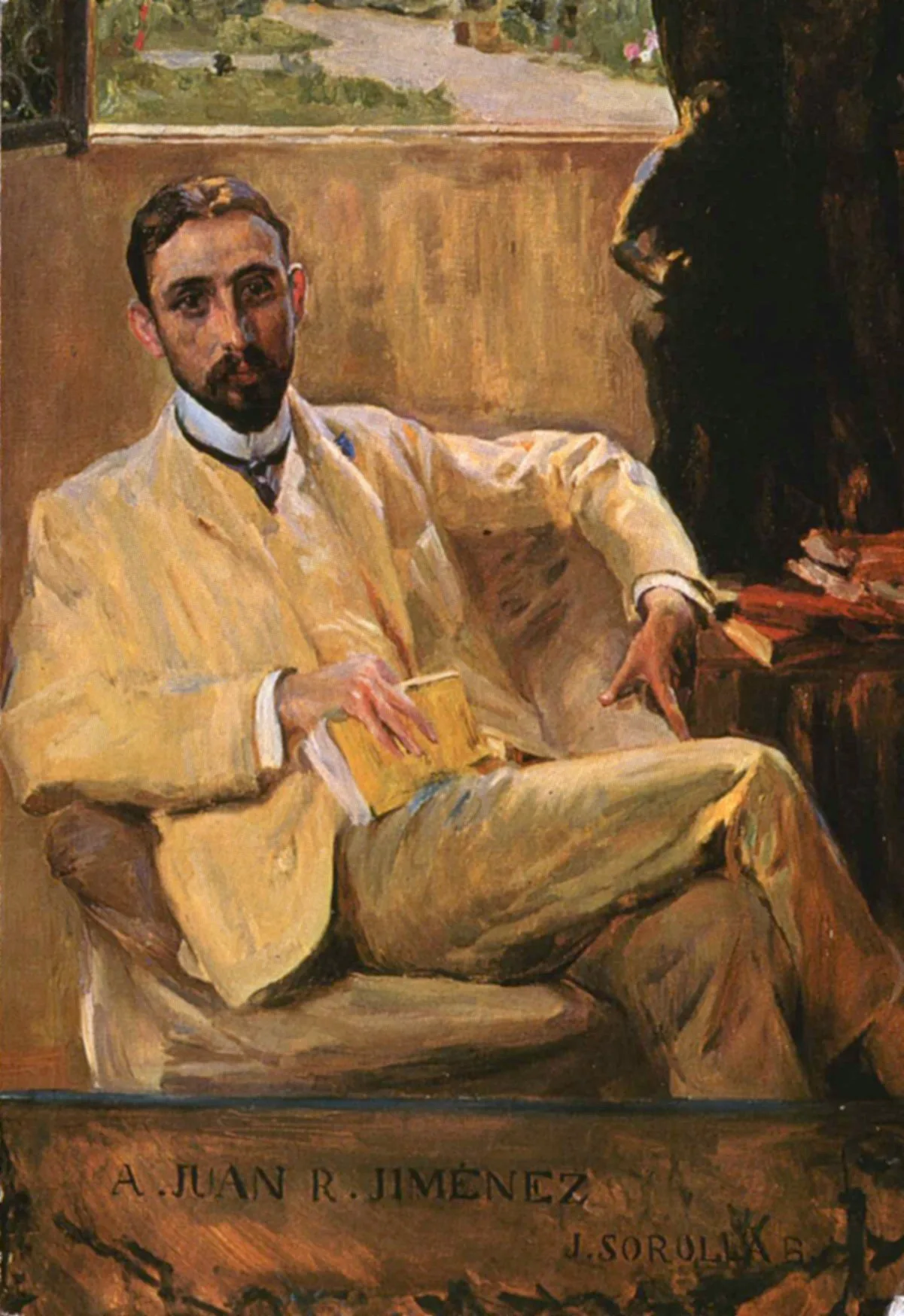
The Swedish Academy announced on October 25, 1956, the Nobel Prize in Literature for Juan Ramón Jiménez. Three days later Zenobia Camprubí died in Puerto Rico. Moguer and the University of Huelva host an international conference from October 26 to 28 to mark the anniversary.
This Sunday, October 25, marks 70 years since the day the Swedish Academy awarded the Nobel Prize in Literature to Juan Ramón Jiménez. This is recorded in the chronology of the Fundación Zenobia-Juan Ramón Jiménez, which manages the poet's house-museum in Moguer. It was Thursday, October 25, 1956.
The Nobel Foundation keeps the official citation for the prize in English: «for his lyrical poetry, which in Spanish language constitutes an example of high spirit and artistical purity». That is, «for his lyrical poetry, which in the Spanish language constitutes an example of high spirit and artistic purity». He was the only Literature laureate that year.
A prize and a mourning
The joy did not last long. Zenobia Camprubí, his wife, translator and collaborator, was seriously ill with cancer in San Juan de Puerto Rico, where the couple had lived since 1951. According to the Ayuntamiento de Moguer, a friend of the couple, Connie Saleva, had written to the Swedish academician Hjalmar Gullberg to ask him to bring the announcement forward, in the hope that Zenobia would live to hear of it.
She did hear of it. The Ayuntamiento records the testimony of the doctor attending her, Doctor Batlle: when the Academy's telegram arrived, Zenobia, who had been «semicomatose», opened her eyes and sang «a song of joy». Juan Ramón then said: «She is the one who deserves it».
Zenobia Camprubí died three days later, on Sunday, October 28, 1956, at four in the afternoon, at the Mimiya clinic in Santurce, according to the Foundation. The following day she was buried in the Porta Coeli cemetery, in Bayamón, near San Juan.
Stockholm, without the poet
Juan Ramón did not travel to Sweden. At the ceremony on Monday, December 10, 1956, he was represented by Jaime Benítez, rector of the University of Puerto Rico, where the poet was a professor. Benítez received the medal and the diploma from the hands of King Gustavo VI Adolfo of Sweden.
The rector also read the laureate's message of thanks, which the Nobel Foundation publishes on its website. In it, Juan Ramón explained that pain and illness forced him to stay in Puerto Rico, and he left a sentence that sums up that autumn: «My wife Zenobia is the true winner of this prize». He added that, without her, he felt «desolate and without strength».
The 1956 prize was endowed with 200,123 Swedish kronor, according to the Nobel Foundation, which calculates its current value at about 3.4 million kronor. The Fundación Zenobia-Juan Ramón Jiménez states that the poet sent half of the prize to his museum in Moguer.
The return to Moguer
Juan Ramón Jiménez died in Puerto Rico on May 29, 1958, a little more than a year and a half after his wife. The remains of both were transferred to Spain and buried in the cemetery of Jesús de Moguer on Friday, June 6, 1958, according to the Foundation. They rest in a granite pantheon, built in 1959, in the San Pedro courtyard of the cemetery.
That same year the house-museum opened its doors, in the house on the street that today bears his name, where the poet lived his childhood and youth. The official opening was on November 14, 1958. The Diputación de Huelva had bought the building, and Juan Ramón himself asked that Zenobia's name appear first. Today it is managed by a foundation made up of the Diputación, the Ayuntamiento de Moguer, the Junta de Andalucía and the Universidad de Huelva.
The birthplace is at calle Ribera, número 2. There he was born on December 23, 1881, according to the Foundation. In Moguer he wrote much of his early work and set «Platero y yo», whose first, abridged edition came out in 1914; the complete one arrived in 1917.
What is being done this year
The Foundation and the City Council have not announced a specific event for this Sunday. The commemoration is concentrated in these weeks:
Piece of the Month. The house-museum dedicates its October Piece of the Month to the Nobel and to the death of Zenobia. It was presented on October 6 by the councillor for Culture, Eva Rodríguez, and the researcher Rocío Bejarano, from the Centro de Estudios Juanramonianos. It brings together international press clippings, photographs of the award ceremony to Jaime Benítez, the programme, the menu and the seating plan of the Stockholm events and the manuscript of the poet's message of thanks.
International congress. From Monday, October 26 to Wednesday, October 28, the congress «Zenobia Camprubí, Juan Ramón Jiménez y el 27. Magisterio y vigencia» is held, organised by the Asociación Colegial de Escritoras y Escritores de España en Andalucía. It is directed by Manuel Gahete, Manuel Ángel Vázquez Medel, Rosa García Gutiérrez, director of the Cátedra Juan Ramón Jiménez of the Universidad de Huelva, and Antonio Ramírez Almanza, director of the house-museum. Admission is free until full capacity is reached.
On Monday, October 26 the venue is Moguer. The opening, at 11.30 in the plenary hall of the City Council, is given by the mayor, Gustavo Cuéllar, with the councillor for Culture, Patricia del Pozo, and the president of the Diputación, David Toscano. At 12.30, Alfonso Alegre Heitzmann gives the lecture «El Nobel de Juan Ramón Jiménez: destino y leyenda». In the afternoon there are round tables on his relationship with other Nobel laureates, such as Tagore, Neruda and Gabriela Mistral, and on Juan Ramón and the 27.
On Tuesday, October 27 and Wednesday, October 28 the congress moves to the lecture hall of the Facultad de Humanidades of the Universidad de Huelva. On Wednesday, when 70 years since the death of Zenobia are marked, the day is dedicated to her: at 10.00, Emilia Cortés Ibáñez speaks about her diaries and her correspondence. The closing, at 12.15, brings together Toscano, the rector of the Universidad de Huelva, José Rodríguez Quintero, and the president of the writers' association, Manuel Rico.
Perejil de Plata. The Foundation will present on November 4, at the monastery of Santa Clara, its Perejil de Plata 2026 to Antonio Ramírez Almanza, director of the house-museum since 1999, according to the City Council.
Exhibition. On November 12 an exhibition opens in which artists from the province work with fragments of the disappeared pine of Fuentepiña, within the municipal programme Luna de Otoño.
The Premio Iberoamericano de Poesía Juan Ramón Jiménez, convened by the Diputación and organised by the Foundation, has already been decided and awarded this year: it was won in June by the onubense Enrique Zumalabe with «Gramática del desorden», the first author from the province to achieve it in 46 editions, according to the Diputación. The book was presented on October 20 at the Feria del Libro de Huelva.
How to visit the house-museum
The Zenobia-Juan Ramón Jiménez house-museum is at calle Juan Ramón Jiménez, 10, in Moguer. In winter hours, from October 1 to May 30, it opens from 10.00 to 14.00 and from 16.00 to 19.00; on Sundays, mornings only. It closes on Mondays and public holidays, and the last entry is half an hour before closing. This Sunday, therefore, it can be visited in the morning.
Admission costs 3.50 euros; 2.50 euros for students, retirees and groups of at least 20 people, and 9 euros for the family ticket. It is free for unemployed people, people with disabilities and residents of Moguer and Mazagón, with accreditation. Tickets are only sold at the house itself. The visit is guided, with a maximum of 25 people per slot, and the Foundation recommends booking on 959 37 21 48, Monday to Friday in the morning.
The tomb of Zenobia and Juan Ramón is in the cemetery of Moguer, at avenida de la Constitución, 181. In winter it opens every day from 9.00 to 13.00 and from 16.00 to 18.00, according to the Foundation.